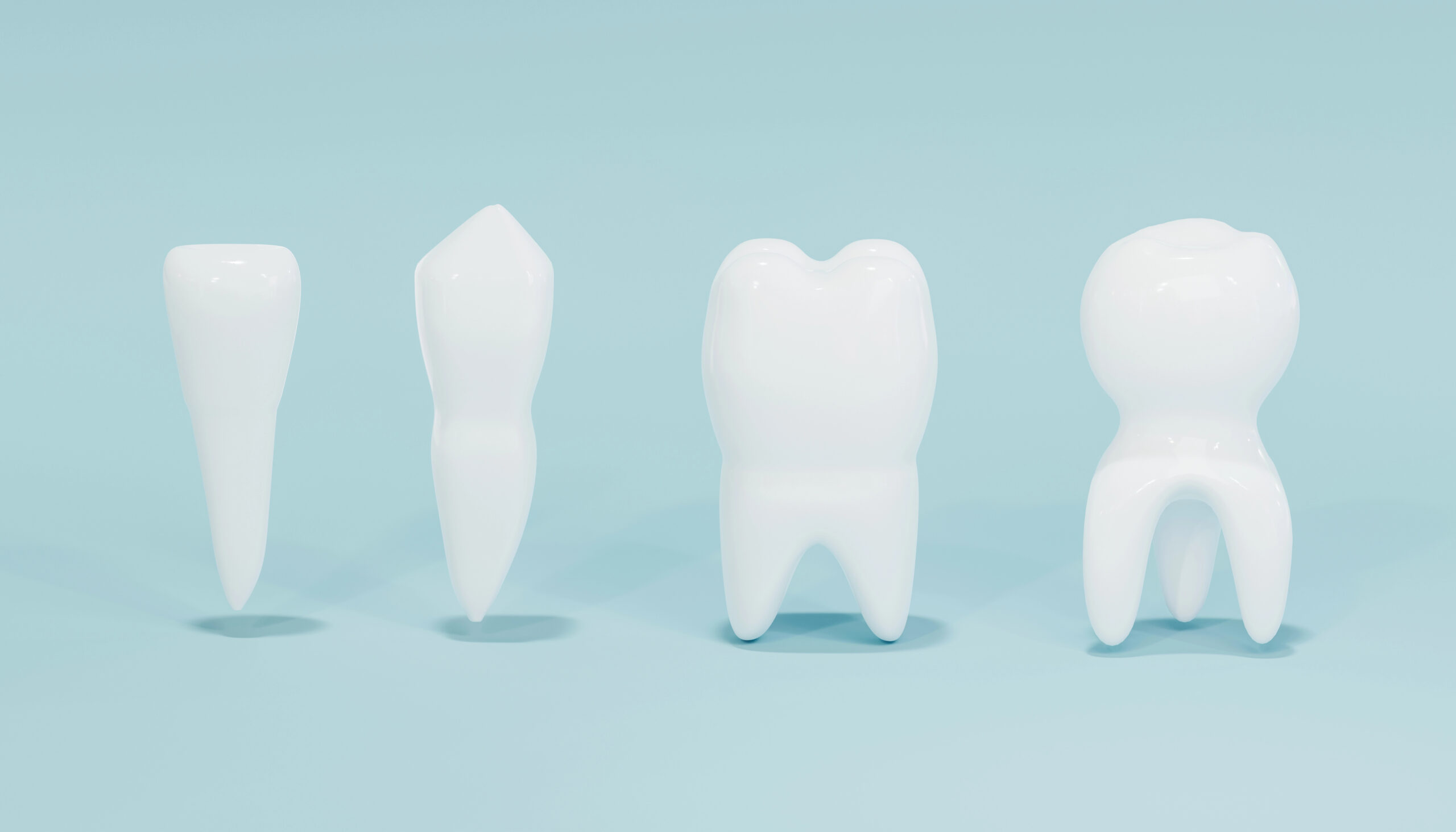
Did you know that each tooth in your mouth has a unique shape and a specific job? Recognizing their individual roles (and vulnerabilities) can help you improve your oral care routine to keep every single tooth healthy, strong, and functioning at its best.
Types of Teeth
An adult mouth typically contains 32 permanent teeth, which are divided into four distinct categories based on their shape, location, and function. These types are incisors, canines, premolars, and molars. Each one is designed to handle food in a different way. Let’s find out more about each type and learn how to care for them.
Incisors
Located at the very front of your mouth, the incisors are the eight teeth (four on top, four on bottom) that you see at the front and center every time you smile. Their name comes from the Latin word “incidere,” which means “to cut,” since that is what they are designed to do.
Shape and Function
Incisors are thin and flat with a sharp, blade-like edge. Their primary job is to cut into food, acting like scissors to take that initial bite. They are not built for grinding or heavy chewing. Because they are in the front of your mouth, they also play a significant role in your appearance and in the pronunciation of certain sounds.
Common Issues and Care Tips
Due to their thinner shape and prominent location, incisors are particularly susceptible to certain problems.
- Chipping and Fractures: Biting down on hard things like ice, fingernails, or pen caps can easily chip or crack these more delicate teeth. It’s also common for incisors to be injured during sports or accidents.
- Visible Stains: As the most visible teeth, stains from coffee, tea, or red wine are often most noticeable on incisors.
- Plaque on the Back: The back surfaces of the lower incisors are a common spot for tartar to build up because they are close to a salivary gland and can be awkward to brush.
To care for your incisors, focus on gentle but thorough brushing, and don’t forget the inside surfaces. When drinking potentially staining beverages, using a straw can bypass these teeth to prevent stains. Lastly, if you play sports, definitely use a mouthguard for protection.
Canines
Flanking the incisors on each side are the four canines, two on top and two on the bottom. Also known as cuspids, these teeth are distinct for their pointed shape.
Shape and Function
Canines are the sharpest teeth in your mouth. Their primary function is to grip and tear food that is too tough for the incisors to cut. They are surprisingly sturdy, with the longest roots of any teeth. These strong roots and their position in the corners of the mouth support the structure of your lips to play a function in speech as well.
Common Issues and Care Tips
The pointed tip of a canine is excellent for its job, but it can also present some unique challenges. It can be difficult to clean, making canines susceptible to plaque and tartar buildup at the gumline. Canines are also susceptible to wear, especially in people who grind their teeth.
When brushing, pay special attention to the gumline around your canines, ensuring your bristles are angled to clean where the tooth meets the gums.
Premolars
Premolars, or bicuspids, are further back behind your canines. Adults have eight premolars, four on the top and four on the bottom. These teeth serve as a transition between the tearing canines and the grinding molars.
Shape and Function
Premolars are larger than incisors and canines and typically have two pointed cusps on their biting surface. This unique shape gives them a hybrid function. They can both tear and crush food, breaking it down into smaller, more manageable pieces before it gets passed to the molars for the final stage of chewing.
Common Issues and Care Tips
The grooves and fissures on the biting surfaces of premolars can easily trap food particles and bacteria, making them a common site for cavities. The spaces between premolars and their neighboring teeth are also prime spots for food to get stuck, which can lead to decay and gum irritation if not cleaned properly.
Flossing is absolutely critical for cleaning the tight spaces around your premolars. For some patients, dental sealants can be applied to the premolars to provide an extra layer of protection against decay.
Molars
Located at the very back of the mouth, the molars are the largest and strongest teeth. Adults typically have twelve molars in total: six on top and six on the bottom, including the four wisdom teeth (third molars), which many people have removed.
Shape and Function
Molars have large, broad chewing surfaces with multiple cusps. Their job is to do the heavy lifting of chewing and grinding food so it can be easily swallowed and digested. Their large size and multiple roots anchor them firmly in the jaw to withstand the pressures of serious chewing.
Common Issues and Care Tips
Like premolars, the deep pits and fissures on the chewing surfaces of molars make them highly susceptible to decay. Their location at the back of the mouth also makes them more difficult to reach and clean effectively with a toothbrush and floss. This is why molars are the most common teeth to develop cavities.
To protect your molars, be meticulous with your oral hygiene. Take extra time to brush the chewing surfaces, sides, and backs of these teeth. Using an electric toothbrush can be especially helpful for reaching these areas. Daily flossing applies to all teeth- so don’t neglect your molars, even if they are more difficult to reach.
Check Up on All Your Teeth
Regular dental check-ups and cleanings are extremely important for all your teeth. Contact our office today to schedule your next appointment!